Game club sign-up
Meets: ______________ Room: ________ Adviser: ______________
| Name | Grade | Favorite game | Can bring a game? |
|---|---|---|---|
Nov 22–28, 2026Thanksgiving week
Guide · teachers and clubs
How teachers and parent volunteers use board and card games in class, which games fit which grade, how to run a game day for a whole room, and how to turn the leftover enthusiasm into a weekly school game club.
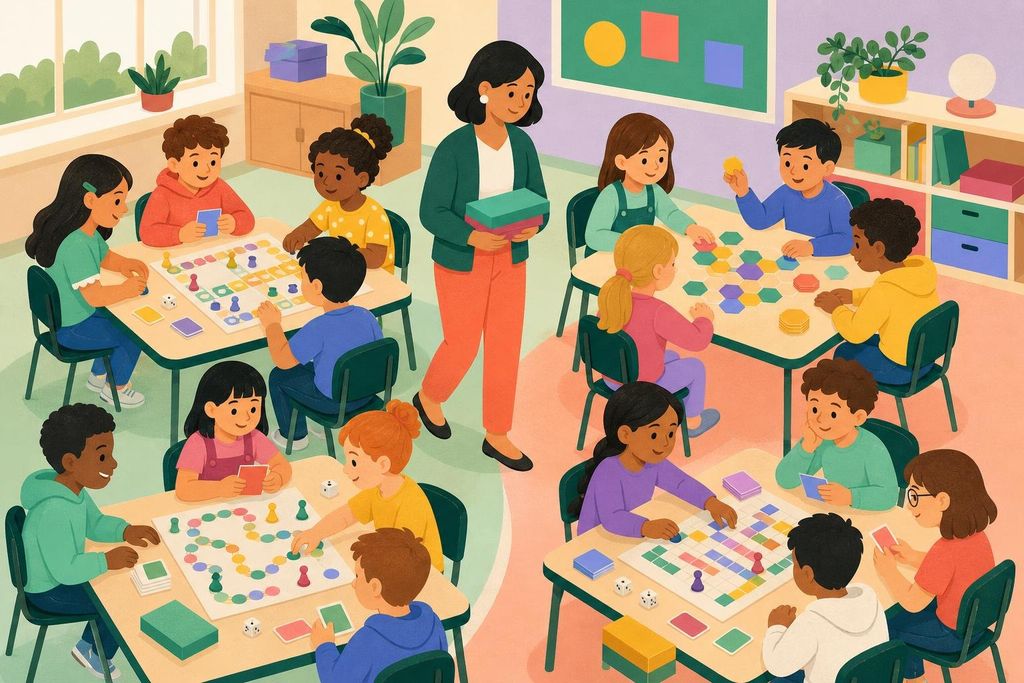
Groups of 4one game per table, rotate every 25 minutes
Under 20 minthe longest a rules lesson should take
5 stepsfrom a single game day to a weekly club
Teachers who use games regularly tend to point to the same short list. A game asks children to read rules or cards, listen while others explain, follow directions in order, wait their turn and lose without sulking. Many games add counting, adding up scores, judging distances on a grid or reasoning about what an opponent will do next. None of that needs a worksheet, and the benefits of board games for kids carry on well beyond the classroom.
Games also give a different way in for students who struggle to sit still with a textbook. Moving a piece, sorting cards and handling dice turn an abstract idea into something on the desk. A child who will not volunteer an answer in front of the class will often argue a point happily with three classmates over a board.
The original National Games Week argued that tabletop games deserve a place next to literature, textbooks and models as a teaching tool. Its school pages singled out students who learn best through hands-on activity, and suggested a well-chosen game might be the one thing that reaches a child who has stopped trying in class.
Pick games by what the class can already do, not by the age printed on the box. A game that is slightly too easy runs itself; one that is too hard turns into twenty minutes of the teacher reading the rulebook aloud.
Roll-and-move games with numbered tracks, matching games and simple dice games build counting and number sense. Keep turns short and choose games where nobody is knocked out early. A cooperative game, where the class plays together against the board, avoids tears at the end.
This is the age for word games such as Scrabble with a relaxed dictionary rule, pattern games like SET, and spatial games like Blokus, where children fit shapes onto a shared grid. Light trading games bring in addition and a little negotiation.
Older students can handle real strategy games and the longer rules that come with them. History-themed games give a social studies class something to argue about, and a game like Settlers of Catan quietly teaches probability: the numbers six and eight come up more often than two and twelve, and good players notice.
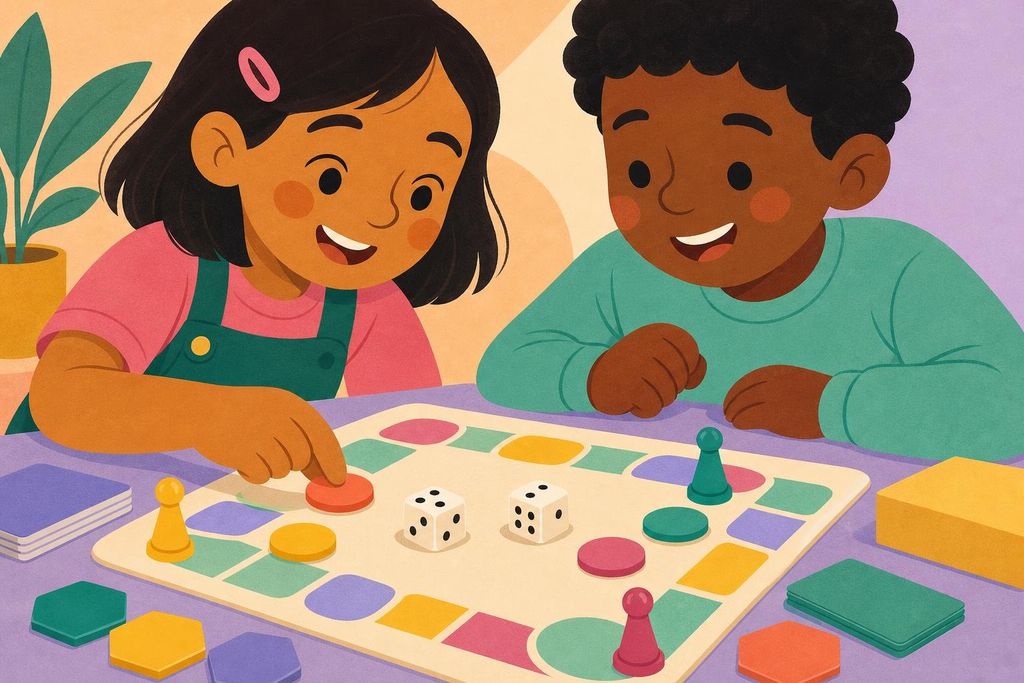
Push desks into tables of four and put one game on each. Four is the sweet spot: everyone gets a turn often, and one student can read the rules while the others set up. Teach the games before the day, either to the whole class or to one table captain per game, so you are not running between groups explaining the same rule five times.
Run the session in rounds of about 25 minutes and rotate tables at the bell, leaving the games where they are. Children get to try several types of games, and slower tables still finish something. Keep a box of short filler games for any group that finishes early. Ten minutes before the end, stop play and ask each table to put its game back together and count the pieces.
Afterward, ask the class which game they would play again and why. The answers make a fine short writing task, and they tell you what to buy next.
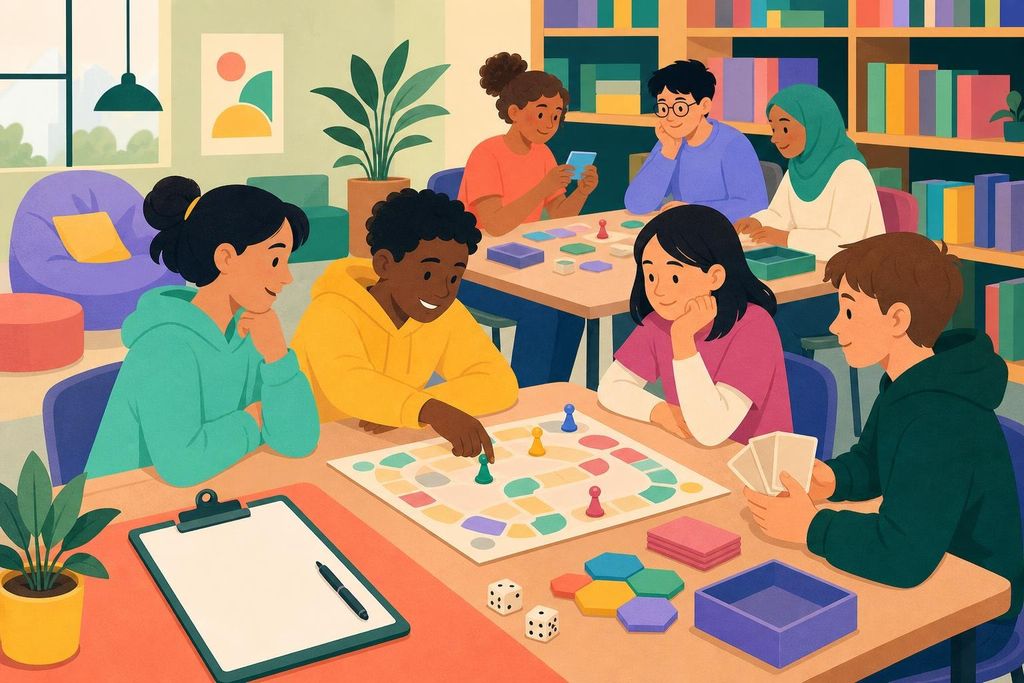
A good class game day usually leaves a few students asking when they can play again. That is the moment to start a club. The steps below assume one adult sponsor and a room for an hour a week.
Most schools need a staff member in the room. The school library, the cafeteria after lunch or a classroom with big tables all work, and a school librarian may already know the format from public library game days. Ask for the same slot every week so students can plan around it.
Eight to ten games is enough to begin: two party games, two quick card games, a co-op game, an abstract game and a few family titles. Families are often glad to donate games their children have outgrown.
Open with ten minutes of free play while people arrive, then one featured game taught by a student or the sponsor. Finish with clean-up and a quick vote on next week's featured game.
Post the printable sign-up sheet in the library and at the main office, and announce the first meeting a week ahead. Ask each student to name a game they already know how to teach.
After a month, hand over teaching to the members. Explaining a game well to a younger student is a real skill, and the club stops depending on one tired adult.
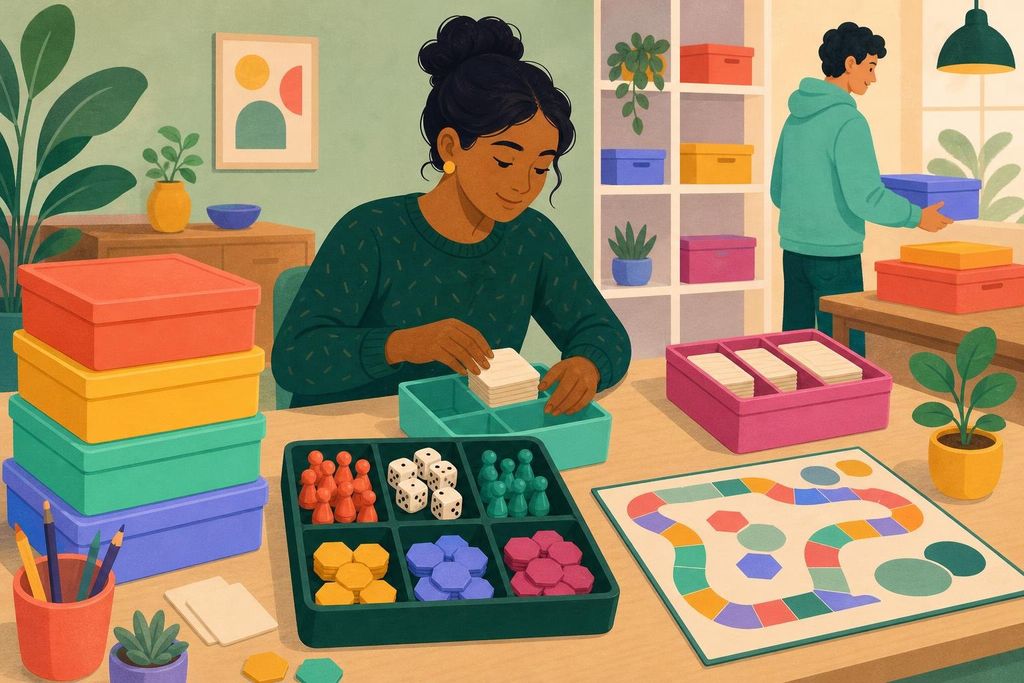
Missing pieces end more school games than boredom does. Store each game in a clear plastic box with a colored label, and tape a list of contents inside the lid so the last group can check before packing up. Sort dice, counters and cards into small trays when a game comes out; it speeds setup and makes losses obvious straight away.
Thrift stores and family donations fill a shelf cheaply, but count the pieces before a game reaches students. A local game store can often recommend titles that teach well and play in under an hour, and the Top 100 games of 2005 still makes a useful checklist of titles worth looking out for secondhand.
National Games Week always falls in the week of Thanksgiving, which in 2026 covers the seven days from November 22 through November 28. Many districts close for part of that week, so a classroom game day fits best on the Monday or Tuesday, when attention is already drifting toward the holiday. The dates for the coming years follow the same rule, so the day can go on next year's calendar now.
Send a note home describing the games the class played. Children who learned a game at school often teach it to relatives over the long weekend, which links neatly to the games for the Thanksgiving table. In 2004 the original National Games Week counted 80 schools among its members, and several ran events across the whole week rather than a single day.
Free printables
The club sign-up sheet has space for twenty names, a grade, the game each student can teach and a parent contact line. Print it on letter paper and post it a week before the first meeting.
FAQ
Choose games that take under 20 minutes to teach and under 45 minutes to play, with four players per table. Dice and counting games suit the youngest grades, word games such as Scrabble and pattern games such as SET suit upper elementary, and strategy games like Settlers of Catan work in middle school. Co-op games help any class where losing causes trouble.
Find a staff sponsor and a room for the same hour each week, gather eight to ten varied games, and post a sign-up sheet a week before the first meeting. Open each session with free play, teach one featured game, and finish with clean-up. After a month or so, let the students take over teaching new games.
Many teachers use them for exactly that. Games ask children to count spaces, add scores, compare numbers and think about chance, and they repeat those skills far more often than a worksheet would. Results depend on the game and how it is used, so pick titles where the math is part of every turn rather than an occasional question.
Four is the best default. With four players everyone gets turns often, one student can read the rules aloud, and a class of 28 needs only seven copies or seven different games. Party games can take a larger group, and two-player abstract games can fill a quiet corner for students who prefer a calmer table.
Early in the week usually works best. National Games Week runs Sunday to Saturday around Thanksgiving, and many schools close for part of the holiday, so Monday or Tuesday gives a full day before the break. In 2026 that means Monday, November 23 or Tuesday, November 24. Check your own district calendar before planning.
The original organizers' school pages listed reading, cooperation, listening, following directions, logical thinking, spatial reasoning and sportsmanship, along with subject knowledge in writing, math, science and social studies. Teachers who use games today point to much the same list, with turn-taking and losing gracefully added for the youngest grades.
Store each game in a clear plastic box with a colored label and tape a contents list inside the lid, so the last group can check before packing up. Sorting dice, counters and cards into small trays during play speeds setup and makes losses obvious straight away. Count the pieces of donated games before students get them.
A class game day works well in rounds of about 25 minutes, with tables rotating at the bell and the games left where they are. Two or three rounds fit into an ordinary lesson block, and a box of short filler games covers any group that finishes early.
Updated