List · 9 genres
Types of board games: nine genres in one list, for kids and families
A board game genres list for anyone choosing what to put on the table: nine kinds of tabletop games, how many players each suits, how long it takes to learn and play, and which titles from the 2005 Top 100 fit where.
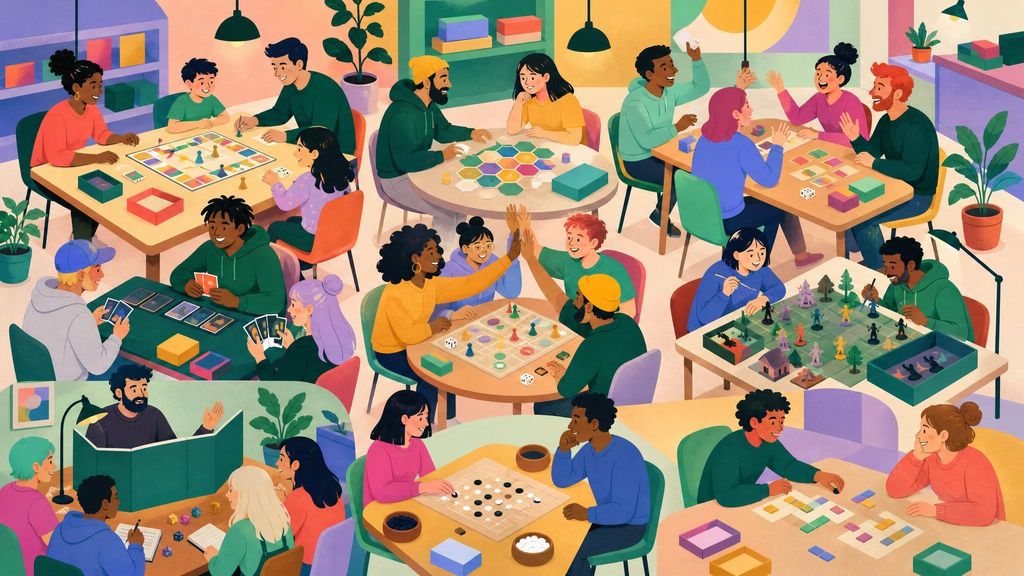
Types of board games and how the genres differ
Most arguments about types of board games come down to one question: what are the players actually doing on their turn? In a family game they roll, draw or place a single piece. In a strategy game they juggle scarce resources and plan several turns ahead. In a party game they talk, guess or act, and the board barely matters. That one test sorts nearly every box on a shelf faster than the box art does.
Genres also overlap. Ticket to Ride is a family game with a light layer of planning, and Arkham Horror is a cooperative game that borrows heavily from role-playing. Treat the nine genres below as neighborhoods rather than fenced lots, and use them to guess how an evening will feel before anyone opens the box. Seen this way, the types of board games work less like a ranking and more like a menu.
From seven categories to a nine-genre list
When National Games Week started in 2004, its organizers sorted games into seven groups: board games, card and collectible card games, miniatures, role-playing, party and trivia, educational games, and family and general interest titles, with a nod to accessories such as dice and terrain. This list keeps most of those groups but splits them the way players describe games now. Strategy and cooperative games get entries of their own, abstract games are separated from family titles, and word games share a slot with trivia.
Educational games are not a separate genre here. Almost every type on the list can teach something, from probability in a dice game to vocabulary in a word game, a point the 2004 organizers made about hobby games in general.
Choosing a tabletop genre for kids, teens or adults
Start with the people, not the shelf. For kids under eight, look for short turns, few rules and chunky pieces: family and abstract games work best, and a cooperative game takes the sting out of losing. Older kids often pick up card games and light strategy quickly, sometimes faster than the adults teaching them. A group of adults who rarely play will usually have a better night with a party game or a family title than with a two-hour strategy game, however glowing its reviews. What each age group gets out of a game, from kids to seniors, is covered in the benefits of board games.
Then check the clock. The original organizers suggested games that take about 20 minutes or less to learn and no more than an hour and a half to play, still a sound rule of thumb for a mixed tabletop crowd. The planner in the guide to hosting a game night matches games to the number of players, and the family game night ideas by age go further into games for kids.
Family games
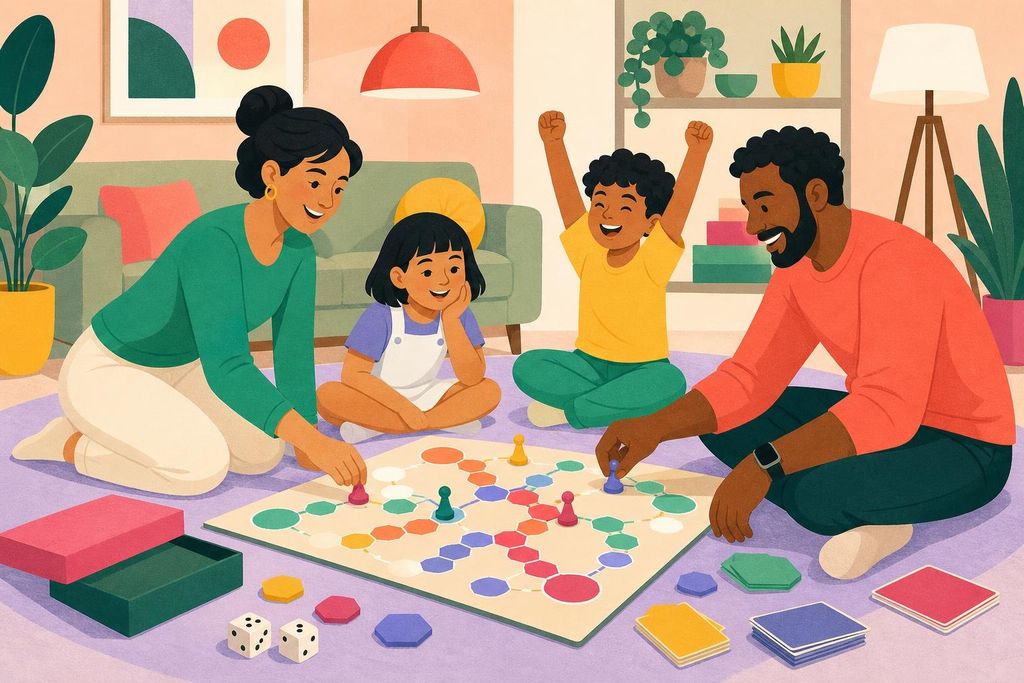
Family games are built so that an eight-year-old and a grandparent can share a table without either one getting bored. The rules fit on a page or two, turns are quick, and a little luck keeps the score close until the end. Many classic American titles sit here, Monopoly and Clue among them, next to newer designs like Ticket to Ride, where players collect colored cards to claim train routes across a map. The best family games let a younger player win on merit, which does more for the mood at the table than any house rule. Expect plenty of chatter and not much silence.
Strategy games
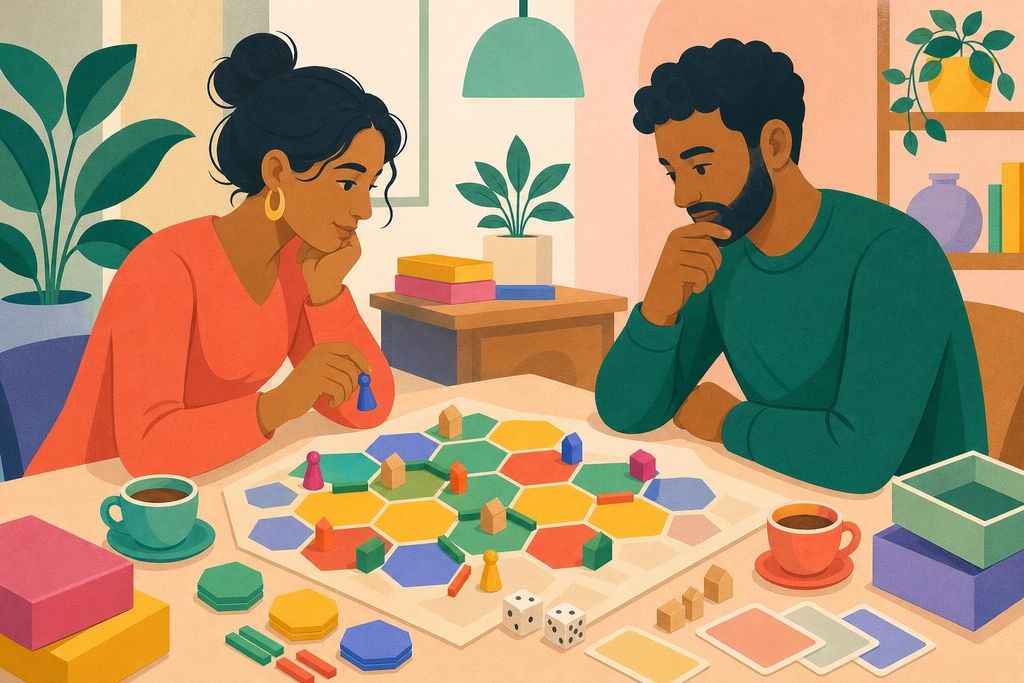
Strategy games reward planning. Every turn asks you to choose between scarce resources, and any luck is small enough that the better plan usually wins. Players often call the modern style Euro games, because many well-known designs came out of Germany in the 1990s, Settlers of Catan among them. In Catan you trade wheat, brick and wool with the other players to build roads and towns. Puerto Rico and Power Grid ask you to run a small economy more directly. They take longer to learn, so it helps if one person has played before and teaches. Two hours can pass without anyone looking at a phone.
Party games
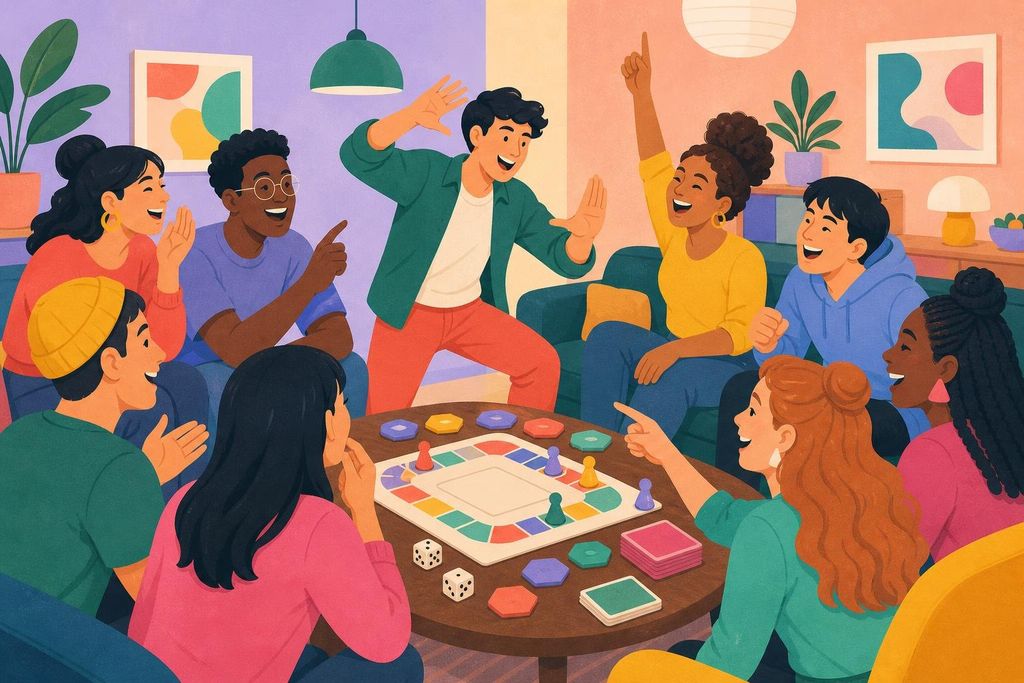
Party games are about the people, not the pieces. They usually take four to twelve players, often in teams, and ask them to guess, draw, act out clues or judge each other's answers. In Apples to Apples one player chooses which card from everyone else's hand best fits a description, so the fun lies in knowing your judge. Time's Up has teams guess the same pile of names over three rounds, with fewer clues allowed each time. The original National Games Week organizers grouped party and trivia games together and suggested keeping them for later in the evening, when energy dips and a big laugh helps.
Cooperative games
In a cooperative game everyone at the table is on the same side, and the game itself is the opponent. Players win or lose together, which changes the mood completely: people show each other their cards, argue about the best move out loud and celebrate as a group. Shadows Over Camelot, from the 2005 list, adds a twist in which one knight may secretly be a traitor. Arkham Horror sends a team of investigators against a slowly building horror story. Co-op games suit kids who hate losing and couples who would rather not compete. Watch for one confident player quietly taking everyone else's turns.
Card and trading card games
Card games range from a single standard deck to games with thousands of unique cards. Simple titles like UNO, Fluxx and Bohnanza need nothing but the box and take minutes to explain. Collectible or trading card games, such as Magic: The Gathering and Pokémon, ask each player to build a personal deck from cards bought in packs, which makes them a hobby as much as a game. In 2004 the members of National Games Week mentioned collectible card games exactly as often as role-playing games. Card games travel well, fit on a small table and fill lunch breaks, car rides and the last half hour of a long night.
Miniatures and war games
War games recreate battles, real or invented, and miniatures games do it with painted figures on a table dressed with model hills, trees and ruins. The hobby is older than most people guess: H. G. Wells published rules for toy soldiers, called Little Wars, in the early 1900s. Board-based war games such as Axis & Allies and Memoir '44 keep everything on a printed map, while Warhammer 40,000 and Heroclix, which topped the 2005 Top 100, move figures measured across open terrain. Many hobbyists spend as many hours painting and collecting as playing. About one in six National Games Week members named miniatures in 2004.
Role-playing games
A role-playing game is a story told together. One player, the game master, describes the world and voices everyone the heroes meet, while the others, usually two to seven of them, each control a single character and say what that character does. Dice decide whether risky actions succeed. Dungeons & Dragons made the form famous after its release in the 1970s and came second on the 2005 Top 100. Call of Cthulhu and Vampire: The Masquerade use the same idea for horror. A session runs two to four hours, and many groups meet again and again to continue one story. It sits closer to improv theater than to a board game.
Abstract games
Abstract games have no theme to speak of: just pieces, a board and usually no hidden information, so a game turns on skill rather than a lucky draw. Chess is the oldest famous example. Newer designs such as Blokus, in which players fit colored shapes onto a shared grid, and Ingenious, a tile game scored across six colors, are quick to teach and pleasant to look at. With no cards to read, abstracts work across languages and reading levels, which makes them handy in classroom game time and at library tables. Most are built for two, though Blokus seats four.
Word and trivia games
Word and trivia games test what you know, or how fast you can find it. Scrabble, probably the best-known word game in the US, has players build crossing words from letter tiles, with bonus squares that reward a big vocabulary and a bit of nerve. Trivia games such as Trivial Pursuit turn general knowledge into a race around the board. Both suit people who enjoy quiet concentration, and both can be played in teams to close the gap between a crossword fan and a ten-year-old. For younger players, simple spelling and picture-word games make a gentle start, and a library usually has a few to borrow.
From the first week
What hosts said they played in 2004
Shares of the game genres named by people who signed up as hosts for the first National Games Week, as the organizers reported them.
Mixing genres in one game night
A good evening rarely sticks to one genre. A common pattern is to open with something short while people arrive, such as a card game, move to the main game once everyone is seated, and close with a party game when attention fades. That rhythm follows the 2004 organizers' advice to balance long games with short ones. If the group splits by taste, run two tables: a strategy game for the keen players and a family or co-op game for everyone else. On a holiday, the Thanksgiving table games fit between courses without clearing the plates.
The genres players named in 2004
When the members of National Games Week listed the kinds of games they played in 2004, board games led with 21.6 percent of mentions. Role-playing and collectible card games tied at 18.6 percent each, followed by miniatures at 16.1, family games at 14.3 and party games at 10.8. Those 2,536 members included 525 game stores and 327 game clubs, so hobby genres score higher than they would in an average household.
The chart shows that split. For the individual titles behind the numbers, the Top 100 games of 2005 lists them by rank, and the history of National Games Week tells how the week began. Use this board game genres list next to the Top 100 and a mixed group can usually find something from three different genres on any well-stocked shelf.
FAQ
Questions people ask
What are the main types of board games?
The nine common types of board games are family games, strategy games, party games, cooperative games, card and trading card games, miniatures and war games, role-playing games, abstract games, and word and trivia games. Many titles mix two genres, such as a family game with light strategy, so the labels work best as a guide to how a game will feel rather than strict boxes.
How many types of board games are there?
There is no fixed number. Stores and fan sites slice games in different ways, from five broad groups to dozens of mechanics such as worker placement or deck building. Nine genres cover nearly everything most households and clubs play, which is why this list uses them. The original National Games Week used seven categories in 2004.
What type of board game is best for young kids?
For kids under about eight, family games, simple abstract games and cooperative games work best. Look for turns that take under a minute, rules an adult can explain in five minutes and pieces that are easy to handle. Co-op games are especially useful for children who get upset about losing, since the whole table wins or loses together.
What is the difference between a strategy game and a family game?
A family game keeps rules short and adds enough luck that anyone can win, so mixed ages stay in the race. A strategy game gives players more choices, less luck and a longer playing time, so careful planning decides the winner. Settlers of Catan sits near the border: simple enough for families, with enough trading and planning to count as strategy.
Are role-playing games a kind of tabletop game?
Yes. Role-playing games such as Dungeons & Dragons are played around a table with dice, rulebooks and character sheets, so they count as tabletop games even though many need no board at all. One player acts as game master and runs the story, and the others each play one character. Sessions are longer than most board games, often two to four hours.
What is a cooperative board game?
A cooperative game has all the players working together against the game itself, so the whole table wins or loses as one. Shadows Over Camelot and Arkham Horror were two of the few on the 2005 Top 100 list. Today cooperative games are a full genre, and they suit young kids and players who dislike head-to-head play.
What are tabletop games?
Tabletop games are any games played around a table with physical pieces: board games, card and trading card games, dice games, miniatures and war games, and role-playing games. The term sets them apart from video games played on a screen.
Which type of board game is best for a big group?
Party games and word and trivia games handle the largest groups, because they can be played in two or more teams. Party games such as Apples to Apples and Time's Up seat four to twelve and teach in about five minutes. For more players than that, split the room into teams or set up a second table.
Updated